Cast Iron vs. Stainless Steel vs. Nonstick: Which Pan Should You Use?
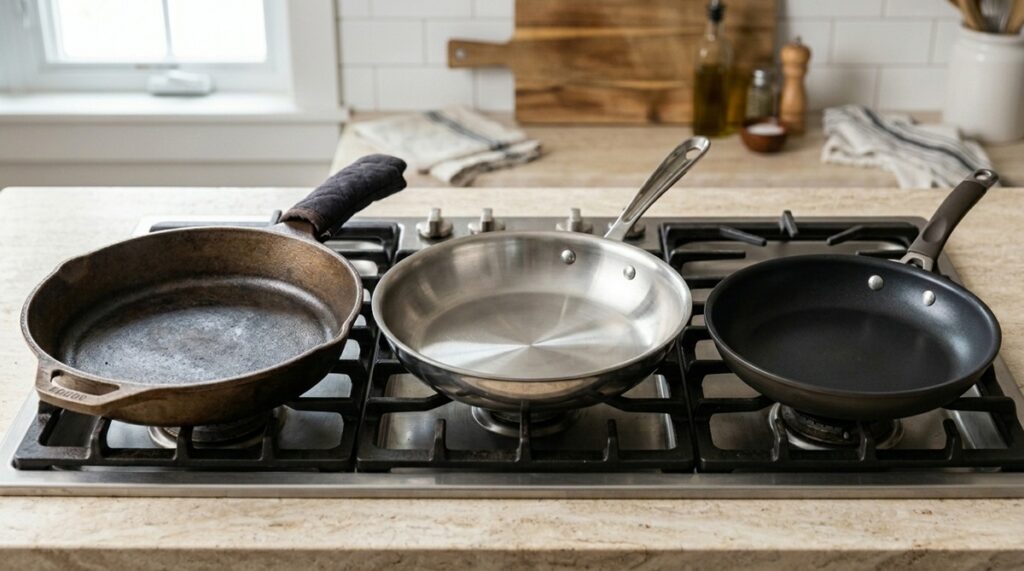
Most home kitchens have all three. However, most home cooks just use whichever is closest (or not dirty). That’s how you end up with a grey, steamed steak from a nonstick skillet, or scrambled eggs welded to a stainless pan. Each material has specific applications where it genuinely excels and specific situations where using it is actively working against the result you want.
Choosing the right pan isn’t about preference, it’s about understanding what each material does and matching it to the cooking task in front of you. Make that choice correctly every time and your food will improve across the board, even if your technique and ingredients stay exactly the same.
This guide breaks down all three honestly: what each one does well, what it doesn’t, how to use it correctly, and what to look for when you buy.
Quick Answer: Which Pan Should You Use?
Use stainless steel for searing proteins, building pan sauces, and any cooking that benefits from fond development. Use cast iron for high-heat searing, sustained-heat applications, and anything going from stovetop to oven. Use nonstick for eggs, crepes, and delicate fish where sticking is a real concern.
Stainless Steel: The Professional Standard
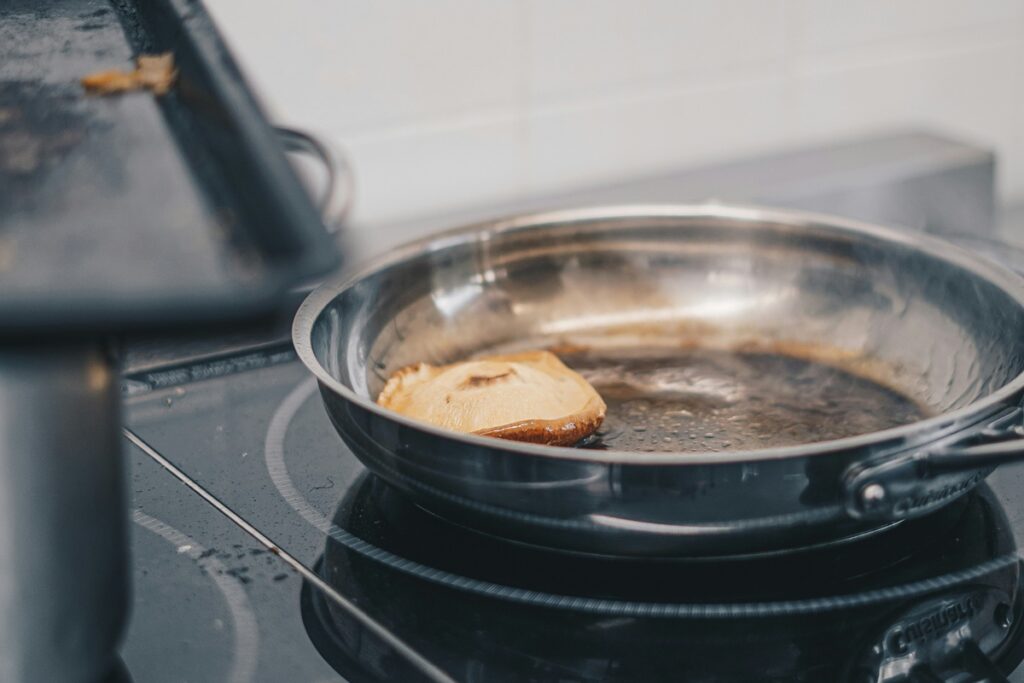
Walk into any professional kitchen and you’ll find stainless steel everywhere. The reasons are practical: it handles high heat very well, creates the fond that makes pan sauces exceptional, is non-reactive with acidic ingredients, goes from stovetop to oven without limitations, and with proper care lasts indefinitely. It’s the all-purpose tool of the cookware world.
What Stainless Does Best
- Searing bone-in chicken pieces, pork chops, duck breast, and fish fillets with skin
- Building and capturing fond for pan sauces and deglazing
- Cooking with wine, citrus, vinegar, tomatoes, and other acidic ingredients
- Stovetop-to-oven applications at any temperature
- Browning aromatics, caramelizing onions, making roux
- Any cooking where you want to see and control color development on both the food and the pan
The Sticking Problem (And How to Fix It)
Stainless steel has a reputation for sticking that is mostly a technique problem rather than a material problem. Cold protein dropped into a cold or insufficiently preheated stainless pan will stick aggressively. But protein seared correctly in a properly preheated pan with fat that’s reached temperature will release naturally when a crust forms.
The test: heat the empty pan over medium-high for 2–3 minutes. Then flick a few drops of water into the pan. If they evaporate immediately with a hiss, the pan isn’t hot enough. If they bead into a single ball and skitter across the surface (the Leidenfrost effect), the pan is ready. Add a thin coat of high smoke point oil, heat for thirty seconds, then add protein.
The second key: don’t try to move the protein. It will stick initially while the Maillard reaction forms the crust. Once the crust develops, the protein releases cleanly. If it resists when you try to move it, it isn’t ready. Wait thirty to sixty seconds and try again.
What to Look For When Buying
Fully clad construction (where an aluminum or copper core runs through the entire pan including the sides, not just the base) distributes heat far more evenly than disc-bottomed stainless. Look for tri-ply (steel–aluminum–steel) or five-ply construction. A pan that feels substantial and doesn’t flex when you press the sides is a good sign. Brands like All-Clad, Tramontina, and Made In offer excellent fully clad options at different price points.
See what other essential tools every home cook needs in their kitchen >>
Cast Iron: Serious Heat, Serious Longevity
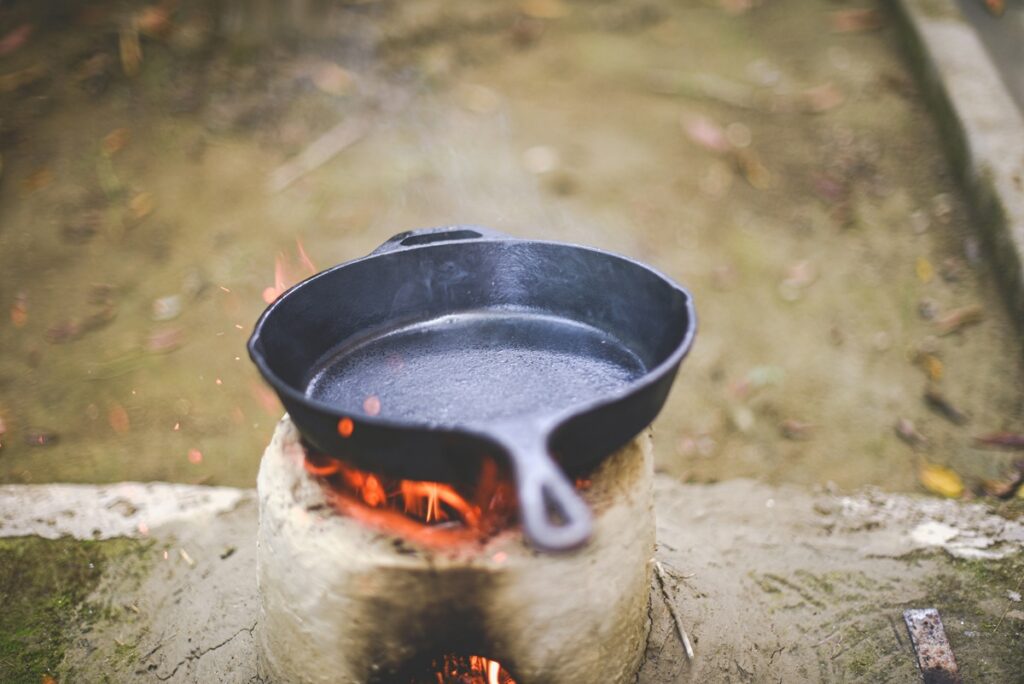
Cast iron is one of the oldest cooking materials still in wide use, and it earns its continued presence through genuine performance advantages. Its defining characteristic is thermal mass — the sheer amount of material that holds heat. A cast iron skillet takes longer to preheat than stainless, but once hot, it holds temperature with remarkable stability. That stability produces cooking results that thin pans simply can’t replicate.
What Cast Iron Does Best
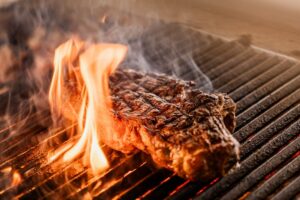
- Searing steaks, pork chops, and burgers where you want the pan temperature to stay stable when cold protein hits the surface
- Stovetop-to-oven cooking from a low to a screaming-hot oven — cast iron handles both
- Baking: cornbread, skillet cookies, cobblers, deep-dish pizza
- Sustained sautéing where you need even heat across the full pan surface
- Frying: the thermal mass prevents the temperature drop when food is added, resulting in less oil absorption
- Any outdoor application like a campfire, gas grill, or charcoal where other pans would be damaged
Seasoning, Maintenance, and Care
Cast iron requires more maintenance than stainless or nonstick, but the requirements are simple once they become habitual. After washing (soap in small amounts is fine. The ‘never use soap’ rule is largely a myth for modern cast iron), dry the pan completely. A few seconds on a low burner evaporates any remaining moisture. Apply a very thin coat of neutral oil and wipe off almost all of it before storing.
The seasoning (the accumulated layers of polymerized oil) builds over time and creates the natural nonstick surface cast iron is known for. A well-seasoned, well-used cast iron skillet from ten years of regular cooking behaves very differently from a brand-new one out of the box. It improves with use.
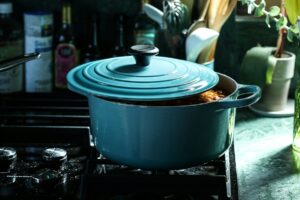
The limitation: cast iron is reactive with highly acidic ingredients over extended cooking times. Long-simmered tomato sauces, wine reductions cooked in cast iron for an hour, or citrus-heavy braises will strip the seasoning and produce a metallic taste. For these applications, use stainless or enameled cast iron.
Nonstick: Useful Within a Narrow Range
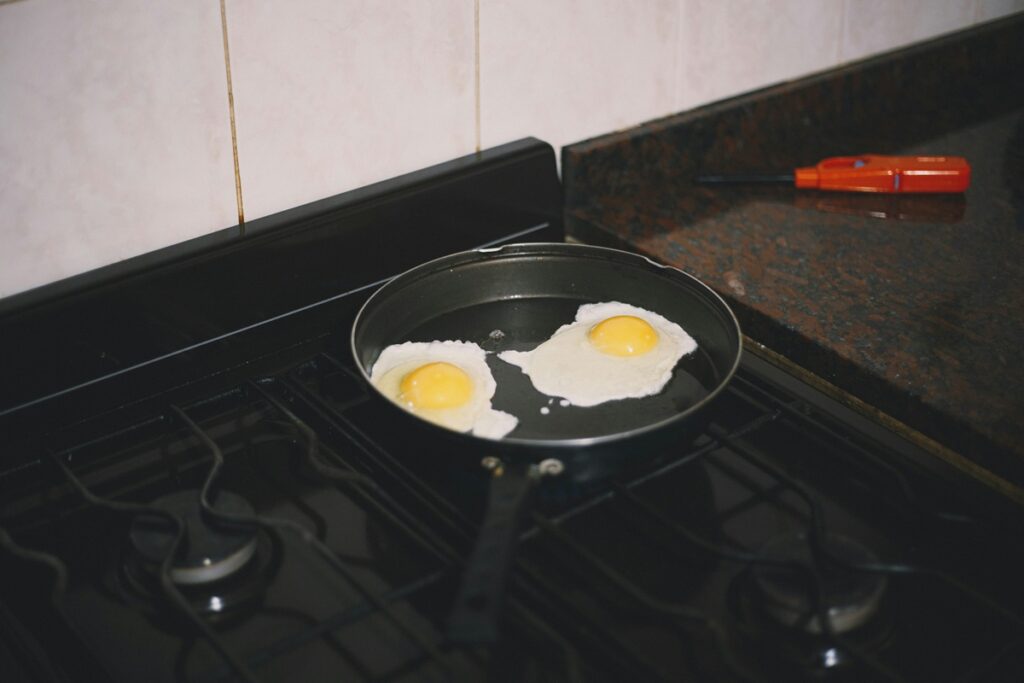
Nonstick cookware is genuinely useful, but it’s consistently misused in home kitchens. The coating — typically PTFE (commonly known as Teflon) or ceramic — is what makes it useful for the specific applications it handles best. It’s also what makes it unsuitable for the broader range of cooking tasks people try to use it for.
What Nonstick Does Best
- Eggs in all forms: fried eggs, scrambled eggs, omelettes, frittatas
- Crepes, thin pancakes, and other delicate flatbreads
- Delicate fish fillets like sole, tilapia, and thin salmon portions where a crust isn’t the priority
- Reheating sticky cooked grains like rice, polenta, or congee
- Caramel and candy making where you need clean release
Where Nonstick Fails
Nonstick should not be used for high-heat searing. Most PTFE coatings are rated to 450–500°F, and a proper sear on a steak requires 450°F at the pan surface before the protein is even added. More importantly, the coating prevents fond development — without fond, there’s no pan sauce, and the flavor of the crust itself is diminished. The result of searing in nonstick is consistently inferior to stainless or cast iron.
Nonstick is also a poor choice for any cooking that involves extended high heat, metal utensils (which scratch and degrade the coating), or a dishwasher (heat and detergent accelerate coating breakdown). Handle nonstick pans with silicone or wood utensils, hand wash them with mild soap and avoid preheating empty over high heat.
Plan to replace nonstick pans every two to four years under regular use, or immediately when the coating shows visible scratching, flaking, or significant discoloration. A scratched nonstick pan is a pan that should be replaced. Don’t cook on it. This is not a category to invest heavily in: a solid mid-range nonstick at $30–$60 outperforms a $150 one on a long enough timeline, since both need eventual replacement.
Side-by-Side Comparison
| Stainless Steel | Cast Iron | Nonstick | |
|---|---|---|---|
| Best use | Searing, pan sauces, versatile | Sustained heat, stovetop-to-oven | Eggs, crepes, delicate fish |
| Heat distribution | Even (clad models) | Very even once hot | Even |
| Searing ability | Excellent — builds fond | Excellent — retains temp | Poor — can’t get hot enough |
| Pan sauce | Best — captures all fond | Good — less efficient | No — degrades coating |
| Oven safe | Yes, unlimited temp | Yes, unlimited temp | Limited — check brand |
| Acidic foods | Fully compatible | Avoid for long cooks | Fine |
| Maintenance | Low — dishwasher safe | Moderate — season and dry | Low — but must be replaced |
| Lifespan | Decades | Lifetime (heirloom quality) | 2–4 years |
| Learning curve | Moderate (heat technique) | Low (once hot, forgiving) | None |
How to Choose in the Moment
The decision framework is simple: does this application need high, dry heat to develop flavor on a surface (a sear, a fond, a crust), or does it need a coating that prevents sticking?
If high dry heat, then reach for stainless or cast iron. Choose cast iron when you want the heat to hold completely stable (thick steaks, large pieces of protein, anything going into a screaming oven). Choose stainless when you want the responsiveness of a pan that heats and cools relatively quickly, and when you want to build a sauce from the drippings.
If delicate and stick-prone, then reach for nonstick. Eggs, thin fish, crepes. Anything where releasing cleanly from the pan is the primary concern and high heat is not.
If you’re unsure, ask: will this benefit from a crust? If yes, nonstick is the wrong pan regardless of how convenient it seems.
Learn how to get the perfect sear on steak >>
Frequently Asked Questions (FAQs)
What is the best pan for everyday cooking?
A fully clad stainless steel skillet is the most versatile everyday pan. It handles searing, sauce-building, stovetop-to-oven cooking, and acidic ingredients without issue. A cast iron skillet is the better choice specifically for sustained high-heat applications.
Is cast iron or stainless better for steak?
Both produce excellent steak, but cast iron has a slight edge for thick cuts because its thermal mass prevents the pan temperature from dropping significantly when the cold steak hits the surface. Stainless is better for building a pan sauce from the drippings afterward.
Why does food stick to my stainless steel pan?
Food sticks to stainless when the pan isn’t properly preheated. The fix is to heat the empty pan over medium-high for 2–3 minutes until the water droplet test passes (drops bead and skitter rather than evaporate immediately). Then add oil, heat briefly, and add food. Protein releases naturally once a crust forms. Don’t try to move it early.
Can you use cast iron on an induction cooktop?
Yes. Cast iron is fully compatible with induction because it contains iron, which interacts with the induction element. It heats more slowly than induction-specific thin cookware but holds and distributes heat extremely well once up to temperature.
How often should you replace a nonstick pan?
Every two to four years under regular home use, or immediately when the coating shows visible scratching, flaking, or significant discoloration. A damaged nonstick coating should be replaced right away. Cooking on it isn’t worth the risk, and the performance has degraded significantly by the time damage is visible.
Can you cook eggs in a stainless pan?
Yes, but it requires careful heat management. A properly preheated stainless pan with adequate butter or oil will cook eggs without any sticking. The technique is more demanding than nonstick. For everyday eggs, nonstick is more practical. For cooking at scale or when nonstick isn’t available, stainless works well with the right approach.