The way you hold a chef’s knife determines everything that follows: the accuracy of your cuts, your speed, how quickly you fatigue, and how safely you work. Most home cooks were never taught a proper grip. They hold the handle the way you’d hold a hammer, which feels natural but gives up almost all the control the knife is capable of providing.
This is one of those foundational corrections that pays dividends across every cooking session for the rest of your life. The correct technique takes about ten minutes to learn and a few deliberate practice sessions to make automatic. Once it clicks, working with a knife feels different. It’s more controlled, more fluid, and significantly less tiring.
Quick Answer: What Is the Correct Knife Grip?
The correct way to hold a chef’s knife is the pinch grip: your thumb and the side of your bent index finger pinch the blade directly, just above the bolster (where blade meets handle). Your remaining three fingers wrap around the handle for support. This places your grip at the balance point of the knife and gives you direct control over the blade rather than the handle.
Why the Handle Grip Falls Short
Wrapping all four fingers around the handle mimics how we hold hammers, golf clubs, and most other tools. The handle grip feels instinctively natural. With a knife, however, it creates a problem. Your hand is as far from the blade as possible, which means small adjustments in your hand produce large, imprecise movements at the cutting edge.
It also creates leverage problems. With a handle grip, the knife tip tends to lift and drop unevenly during rocking cuts, making consistent slices difficult to achieve. The grip requires more squeezing force to feel stable, which causes your hand and forearm to get tired more quickly.
The Pinch Grip: Step-by-Step
Setting Up the Grip
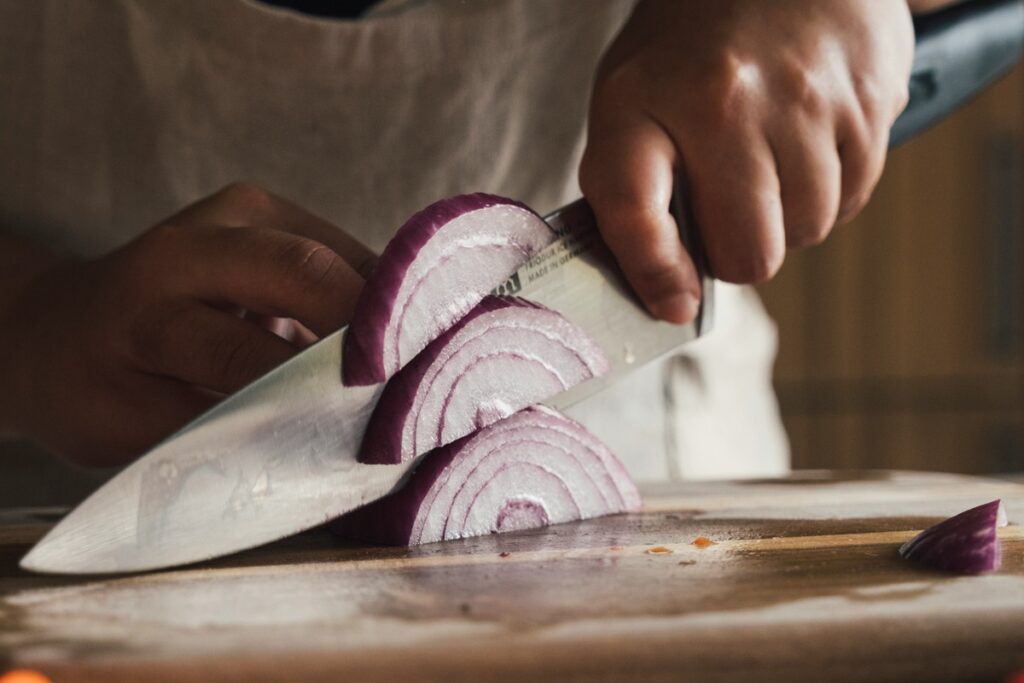
Start by holding the knife loosely by the handle. Now slide your hand forward until your thumb and index finger are positioned directly on either side of the blade, just past the bolster (the thick collar where the blade transitions into the handle). Your thumb presses flat against the left face of the blade. The inner side of your bent index finger presses against the right face.
Now wrap your remaining three fingers around the handle naturally. These fingers provide stability and power. Your thumb and forefinger provide directional control. The two functions are separated, and the grip is precise while also allowing you to have enough force behind your cuts.
What It Should Feel Like
The knife should feel like an extension of your arm rather than a tool you’re gripping at a distance. Because you’re pinching the blade at its widest, most balanced point, the knife sits naturally without requiring constant tension to hold steady. You’ll notice you can adjust the blade’s angle with subtle thumb pressure rather than repositioning your entire hand.
It will feel a bit weird at first. The pinch grip uses muscles in your thumb and index finger that a handle grip doesn’t engage. After twenty minutes of active use, the grip starts to feel natural. After a few sessions, it becomes a habit you’ll use all the time.
The Guide Hand: The Other Half of the System
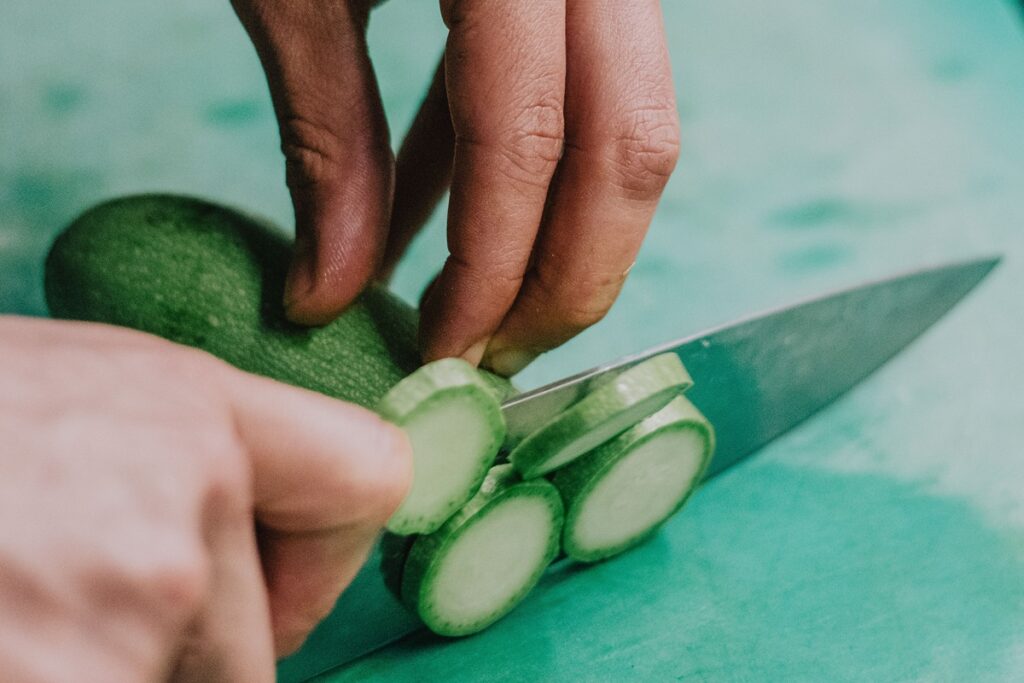
The guide hand (the non-knife hand holding the food) is as important as the knife grip for both safety and precision. Form your guide hand into a claw: fingers curled so the tips are tucked back and the knuckles face forward. The flat side of the blade should rest against your knuckles as you cut.
This claw position has two functions. First, it ensures the blade never rises higher than your knuckles, which means your fingertips are protected regardless of where the blade is. Second, it gives you a consistent surface. As you move the guide hand backward in small, uniform increments, you control the thickness of each slice mechanically rather than by eye. This is how professional cooks produce remarkably consistent cuts at speed.
The most common home cook safety error is laying the guide hand flat on the ingredient. Extending your fingertips while cutting with a sharp knife is a quick way to the emergency room. The claw position eliminates the risk. Use it every single time, even for ingredients that feel stable.
Common Mistakes to Fix
Index Finger Along the Spine
Some people extend their index finger along the top of the blade spine rather than using the pinch grip. This creates a feeling of control but actually reduces it. The finger on the spine produces a lever that makes lateral control worse, not better. It also puts that finger in a vulnerable position if the knife shifts. Keep the index finger on the side of the blade, not on top.
Gripping Too Hard
Tension in the grip transfers directly to the cut and makes movement choppy and imprecise. A tight grip also fatigues your hand much faster than a relaxed one. Hold firmly enough that the knife won’t fly loose, but loosely enough that your fingers could wiggle slightly. A sharp knife in a relaxed pinch grip requires minimal force. The weight of the blade and gravity do most of the work on the downstroke.
Letting the Guide Hand Drift Flat
This happens gradually during a long prep session. The claw position relaxes and the fingers extend. Develop awareness of your guide hand throughout the session and reset to the claw as soon as you notice drift. It’s a habit that requires conscious attention at first and becomes automatic over several weeks.
How to Practice
The fastest way to lock in a new knife grip is slow practice with a specific task. Take a carrot or a zucchini and cut it into thin, even rounds focusing entirely on the pinch grip position and the claw position of the guide hand rather than on speed. Do this for ten minutes before the next few meals you prepare. If you’re using vegetables in your meals, then that’s a perfect time to practice as you do mise en place.
As the grip becomes more automatic, work on consistency. Make each slice the same thickness, at the same speed. Consistency is what transforms a correct grip into a skill. Speed comes naturally once accuracy is stable.
A sharp knife makes this practice dramatically more effective. A dull knife requires force that introduces variability and makes the benefits of correct grip much harder to feel. If your knives need sharpening, address that before or alongside working on grip. We recommend using a simple pull-through sharpener or a whetstone.
The correct grip is the pinch grip: your thumb and the side of your bent index finger pinch the blade just above the bolster, and your remaining three fingers wrap around the handle. This places your control point at the blade rather than the handle, producing far more precise and efficient cutting.
Is the pinch grip safe?
Yes. The pinch grip is significantly safer than holding the handle because it gives you more control over the blade direction and reduces the force required for cuts. Less force means less chance of the knife slipping. Combined with the guide hand claw position, the pinch grip is the safest way to work with a chef’s knife.
How long does it take to learn the pinch grip?
Most people can learn the basic mechanics in under ten minutes. Making it feel natural takes two to four weeks of regular cooking. Making it fully automatic takes a few months of consistent practice. Start with slow, deliberate cuts on easy vegetables and speed will come naturally.
What part of the knife should I pinch?
Pinch the blade itself, just above the bolster (the thick band where the blade transitions into the handle). Your thumb and the inside of your bent index finger contact the flat faces of the blade at this point. The remaining fingers wrap around the handle behind the bolster.
Should I use the pinch grip on all knives?
The pinch grip is most beneficial on chef’s knives and larger utility knives where control and leverage matter. For small paring knives used in-hand for precision tasks, a different grip (often more like a pen hold) is more appropriate. The pinch grip is specifically for board work with larger knives.
Hi, I’m Dylan, the recipe developer, cook, and photographer behind Cooked & Baked, which I run alongside my girlfriend, Jill. Together, we share homemade recipes focused on real ingredients, approachable cooking, and bold flavors.
Most of my time in the kitchen is spent cooking, grilling, and smoking everything from simple comfort foods to slow-cooked barbecue favorites. Outside the kitchen, I also enjoy gardening and using fresh homegrown ingredients in our recipes whenever possible, especially fresh herbs and seasonal vegetables.
Manage Consent
To provide the best experiences, we use technologies like cookies to store and/or access device information. Consenting to these technologies will allow us to process data such as browsing behavior or unique IDs on this site. Not consenting or withdrawing consent, may adversely affect certain features and functions.
Functional
Always active
The technical storage or access is strictly necessary for the legitimate purpose of enabling the use of a specific service explicitly requested by the subscriber or user, or for the sole purpose of carrying out the transmission of a communication over an electronic communications network.
Preferences
The technical storage or access is necessary for the legitimate purpose of storing preferences that are not requested by the subscriber or user.
Statistics
The technical storage or access that is used exclusively for statistical purposes.The technical storage or access that is used exclusively for anonymous statistical purposes. Without a subpoena, voluntary compliance on the part of your Internet Service Provider, or additional records from a third party, information stored or retrieved for this purpose alone cannot usually be used to identify you.
Marketing
The technical storage or access is required to create user profiles to send advertising, or to track the user on a website or across several websites for similar marketing purposes.